Can Better Childcare Provision Reduce the Child Penalty?
Access to childcare plays an important role in mothers’ return to work after childbirth and the number of hours they can work. Studies from several countries find positive effects of childcare expansion on maternal employment. For Austria, however, Kleven et al. (2024) find little effect on income.
One possible explanation is that not all childcare places are equally compatible with employment. Short opening hours and extended closure periods limit the time available for paid work. We therefore focus on childcare places compatible with full-time employment and examine their effects on mothers’ income.
How Extensive Is Childcare Provision in Austria?
In Austria, childcare provision is considerably more extensive for children aged three to five than for children under three. There are also substantial differences between federal states.
Figure 3 shows how childcare provision for children under three developed across Austria’s federal states between 2010 and 2021.
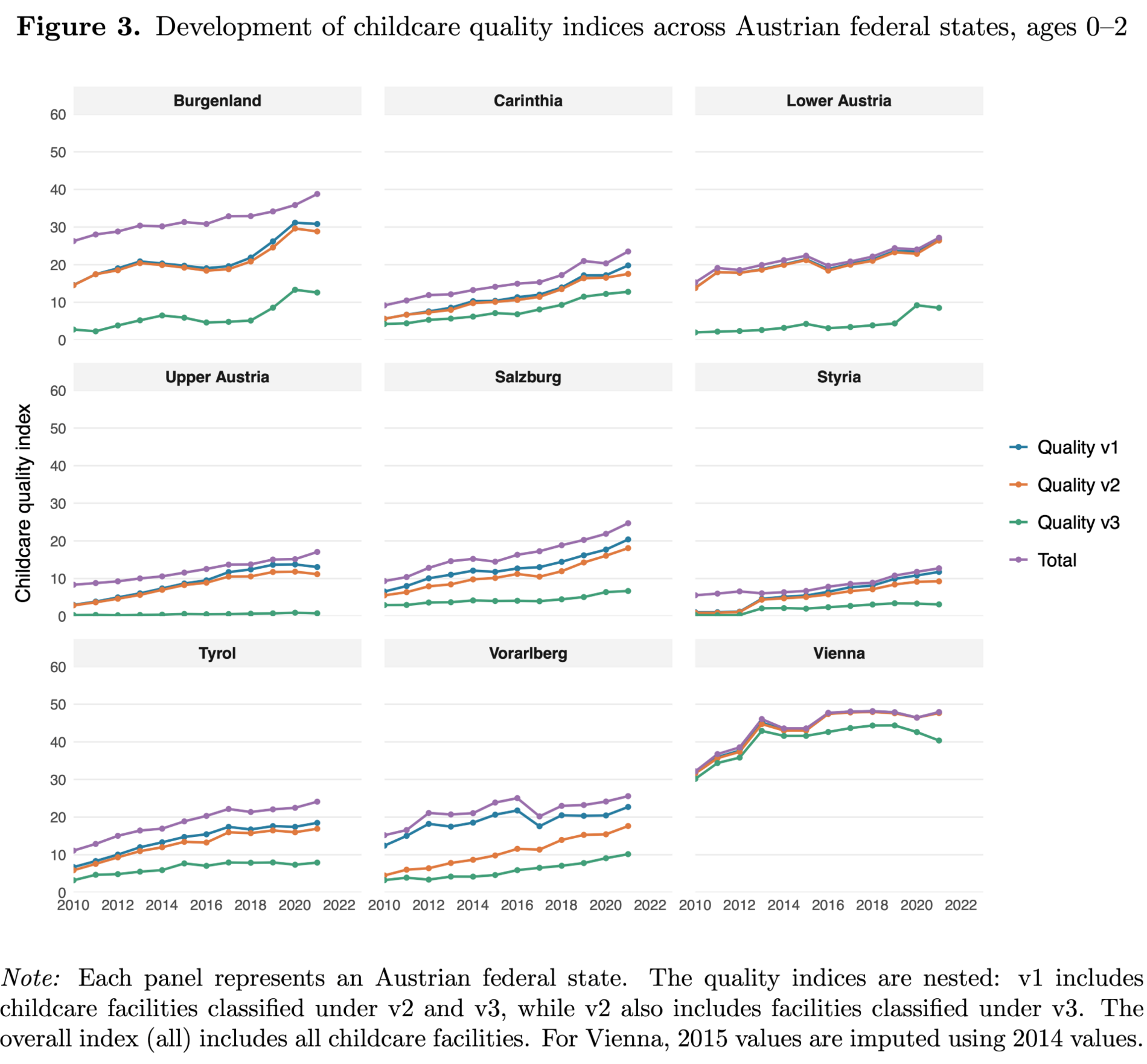
We distinguish between the total number of childcare places and three categories with different requirements for opening hours and annual availability:
- V1: At least 20 hours per week for at least 45 weeks per year.
- V2: At least 30 hours per week for at least 45 weeks per year, with lunch provided.
- V3: At least 45 hours per week for at least 47 weeks per year, including at least 9.5 hours on four days per week, with lunch provided. These places are considered compatible with full-time employment.
We measure childcare availability as the number of places relative to the number of children in the relevant age group in each municipality.
Childcare provision has increased across all federal states, but substantial regional differences remain, particularly in the availability of places compatible with full-time employment (V3).
How Does Childcare Expansion Affect Income?
We examine how mothers’ and fathers’ income changes after a substantial expansion of childcare places compatible with full-time employment for children under three.
Our analysis focuses on municipalities where the childcare coverage rate increased by at least 30 percentage points within one year. For example, this corresponds to an increase from 10 to 40 places per 100 children under three.
Figure 4 shows changes in mothers’ and fathers’ earnings after such an expansion.
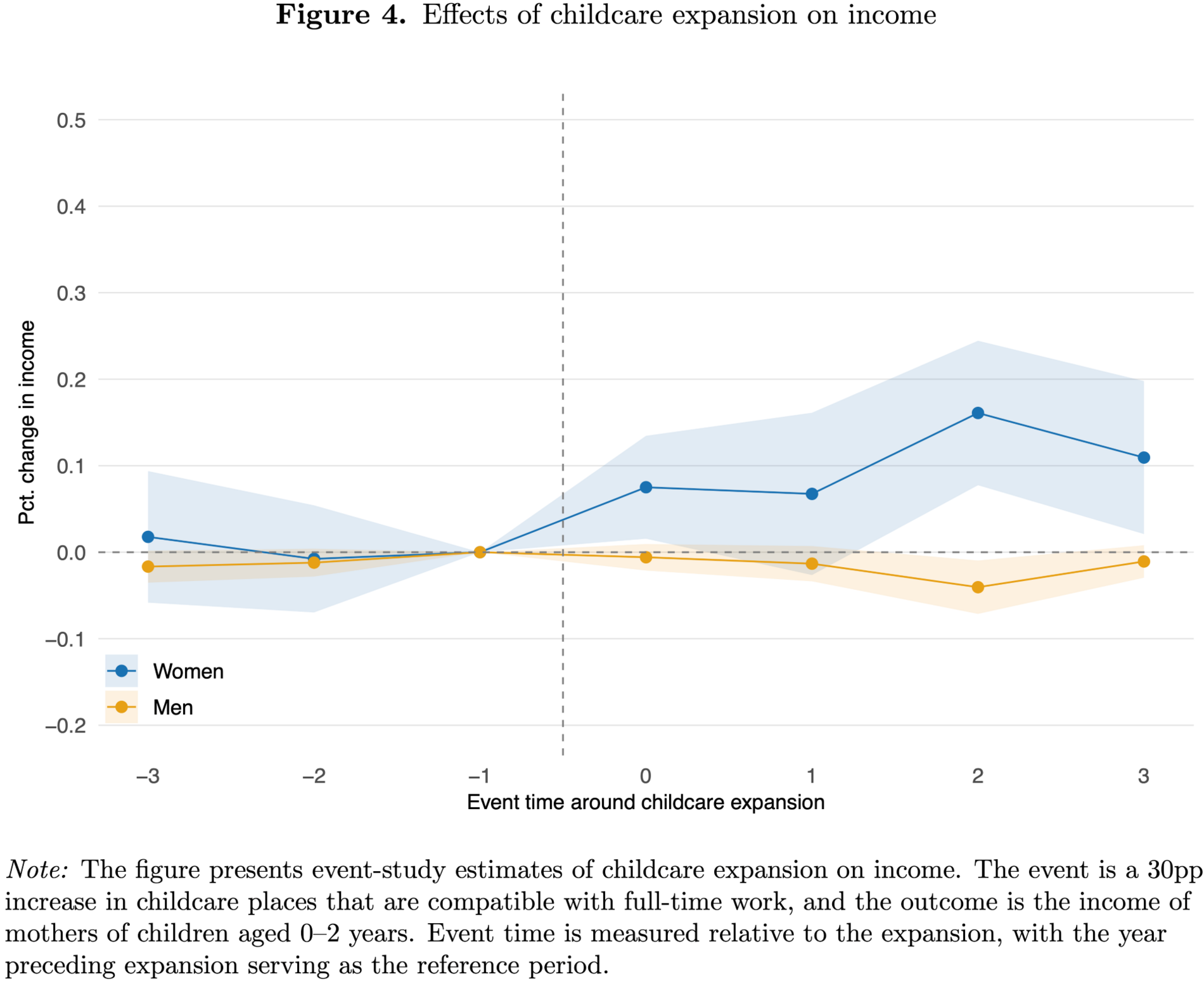
Two years after a substantial expansion, the estimated effect on mothers’ income is around 16%. Fathers’ income shows little change.
Outlook
Further analyses will examine the effects of childcare provision on mothers’ employment and commuting distances, the role of informal childcare, particularly care provided by grandparents, and differences between family groups.
Methodology
We combine Austrian administrative register data on income and employment with information on childcare provision at the municipal level.
We compare mothers’ income in municipalities where the childcare coverage rate increased by at least 30 percentage points within one year with those in municipalities without a comparable expansion. These large increases represent substantial changes in local childcare supply and help us identify their effects on mothers’ income.
We account for differences between municipalities, common economic trends, and mothers’ age and education.

