Research results
Child Penalty, Commuting Patterns, and Childcare in Austria
Research as of November 2026 | Preliminary findings
How does the birth of a child affect the working lives of mothers and fathers? And can better access to childcare help reduce gender disparities in the labour market?
We use Austrian administrative register data to examine how income and commuting distances change after the birth of the first child and whether better childcare provision can reduce mothers’ income losses.
Key Findings
Among mothers who worked full-time before the birth of their first child, income remains around 73% below the expected level four years later, while commuting distances are around 23% lower. Fathers’ income and commuting distances change little.
Mothers who have their first child at an older age experience smaller declines in income and commuting distances and recover faster.
A substantial expansion of childcare places compatible with full-time employment for children under three has a positive effect on mothers’ income. Two years after such an expansion, the estimated effect is around 16%.
Child Penalty and Commuting
How do income and commuting distances change after the birth of the first child? What differences exist between mothers and fathers, and what role does age at first birth play?
[Learn more →]
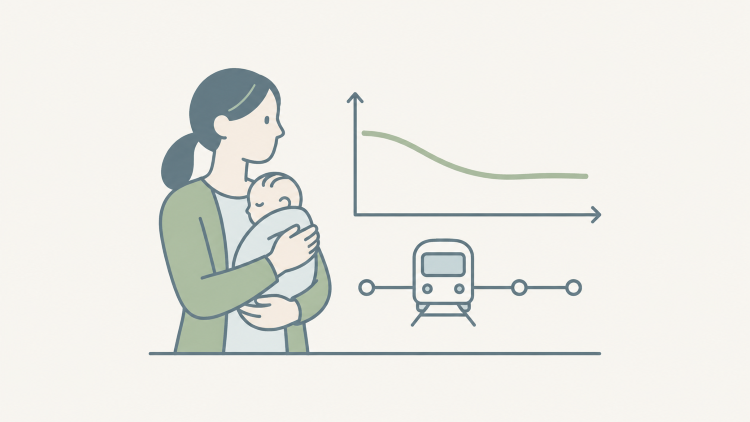
Expansion of Childcare Provision
How has childcare provision developed across Austria? And what effect do additional childcare places compatible with full-time employment have on mothers’ income?
[Learn more →]