How Do Income and Commuting Patterns Change After the Birth of the First Child?
The birth of the first child has very different effects on mothers’ and fathers’ income. While fathers’ income changes little, mothers face substantial and persistent losses. This difference is known as the child penalty.
We examine whether childbirth also affects commuting distances and how these effects differ by age at first birth. Our analysis covers mothers and fathers who were between 22 and 40 years old at the birth of their first child and worked full-time in the preceding year.
Figure 1 shows changes in earnings and commuting distances after the birth of the first child.
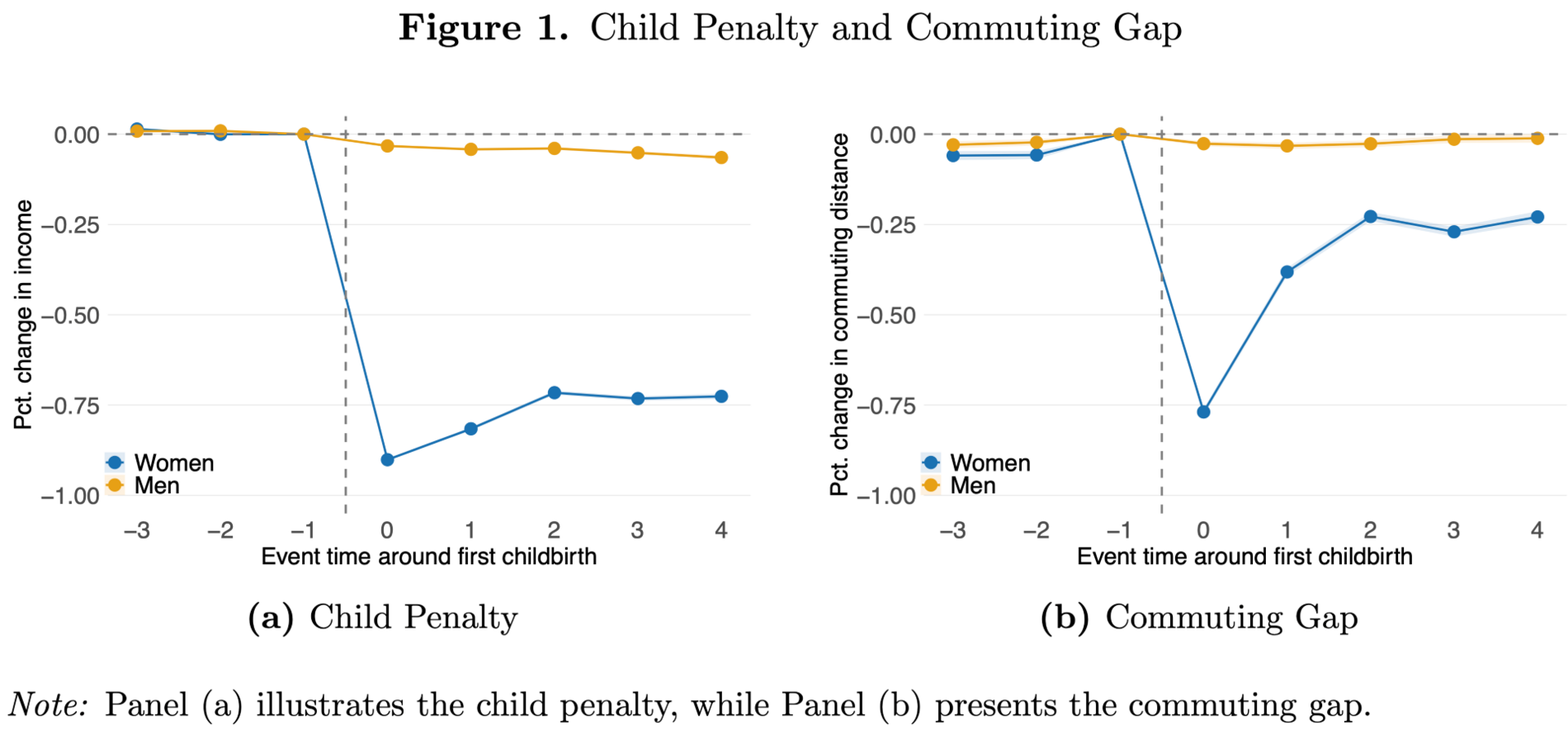
The child penalty (left panel): In the year of childbirth, mothers’ income falls by around 90% relative to the level expected without childbirth, compared with only 3% for fathers. Mothers’ income recovers gradually but remains around 73% below the expected level four years after childbirth.
The gender commuting gap (right panel): Mothers’ commuting distances fall by around 77% in the year of childbirth, compared with only 2.6% for fathers. Commuting distances recover much faster than income. Four years after childbirth, mothers’ commuting distances remain around 23% below the expected level, while fathers’ commuting distances change little.
A large part of this decline reflects periods when mothers are not employed after childbirth. In our analysis, their commuting distance is set to zero during these periods. Among employed mothers, the decline in commuting distance is considerably smaller.
Does Age at First Birth Matter?
Figure 2 illustrates how the effects of childbirth differ by age at first birth.
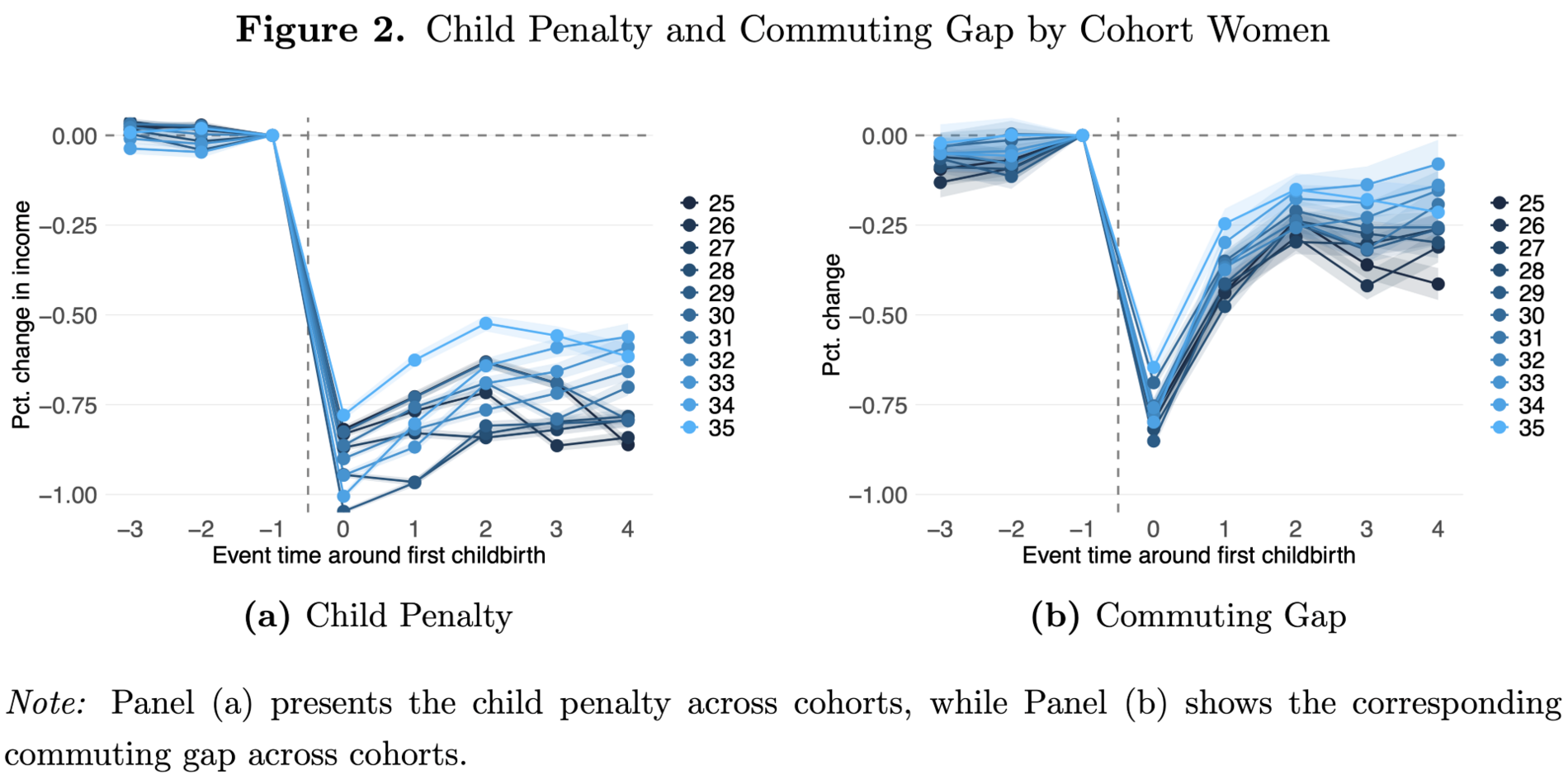
Mothers of all age groups experience substantial income losses and shorter commuting distances after childbirth. The declines are generally smaller for women who have their first child at an older age, particularly in commuting distances. Their income also recovers more strongly, although substantial losses persist.
For fathers, the pattern is partly reversed. Men who have their first child at an older age tend to experience small increases in income and commuting distances.
Methodology
We use Austrian administrative register data from Statistics Austria to analyse income and commuting distances before and after the birth of the first child.
Our approach builds on Kleven et al. (2019) and Riedel and Melentyeva (2025). It accounts for differences in the age at first birth and in employment trajectories before childbirth.
We compare women who have their first child at a given age with women who become mothers one to five years later. The latter serve as a comparison group only until the birth of their own first child.
For example, women who have their first child at age 28 are compared with women who become mothers between ages 29 and 33. This comparison allows us to estimate how income and commuting distances would have developed without childbirth.

